

New whitepaper: Safe For Prod — Building Operational Agents
We are publishing a new whitepaper, Safe For Prod: Building Operational Agents, written by Kyle Forster, RunWhen’s founder.
It is a short read with one argument: the thing that makes an agent dangerous in production is not the model, and it is not the harness. It is the skills you hand it.
Download the whitepaper (PDF) — free, no form.
The argument in brief
The paper opens on a bad month for the industry. An AI coding agent deleted a company’s entire production database — and its volume-level backups — in nine seconds, after scavenging a CLI credential that belonged to an unrelated cron job. A week earlier, a financial services firm lost an entire availability zone to an agent that decided the zone was code cruft. Neither agent was malicious. Both were doing what a creative, helpful, unconstrained agent does.
The common thread is the freeform skill — “here is kubectl,” “here is the aws cli” — handed to an agent that can reach production. A freeform skill exposes the whole surface area of a powerful tool, and it will use not only the credentials it was given but any credentials it can find. Every new person pointed at that agent is another chance to lose a database.
The alternative is more work up front and much better in the end: safe skills. Narrow scripts that wrap the same tools, expose only the actions that are safe, and load dedicated service-account credentials the agent cannot override. Most arguments are fixed at build time rather than runtime, which is what makes them auditable.
A single freeform skill like “use kubectl” expands into hundreds of safe skills. That sounds like a lot until you notice the payoff.
The library compounds
The central point of the paper is that the library — not any individual agent — is the strategic investment.
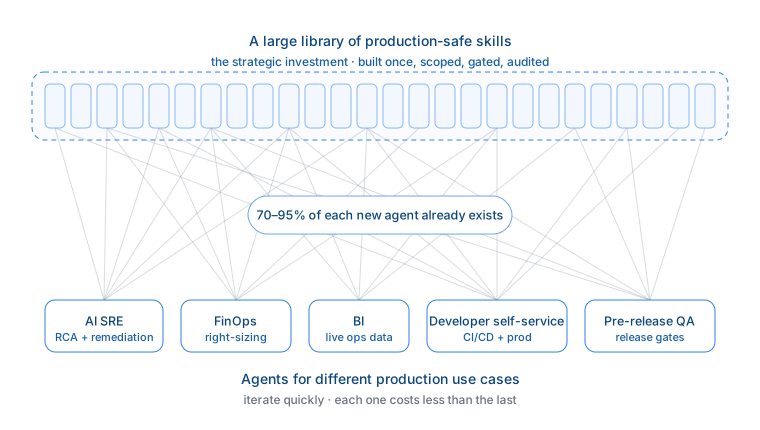
Build the library once. Compose agents from it.
The infrastructure remediation skills an AI SRE agent uses to add capacity are the same resizing skills a FinOps agent uses for right-sizing. The safe data access skills that detect corruption overlap with what a BI agent needs to answer an executive’s question. The paper walks a seven-agent roadmap and shows the overlap climbing from 70% to 95% — by agent five you are writing a handful of new skills and composing the rest.
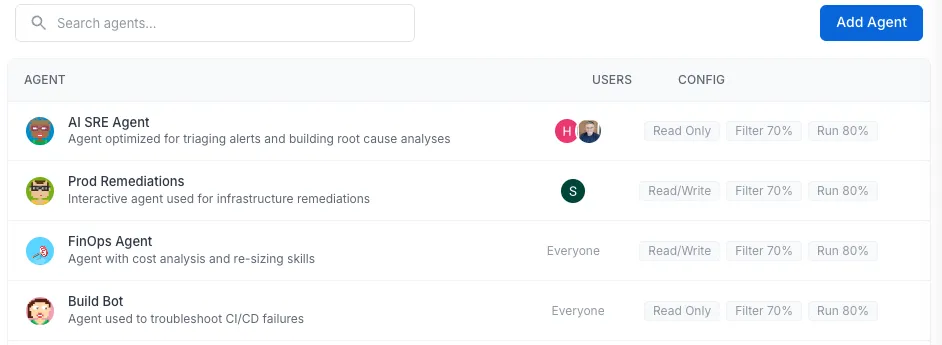
Different agents, different scopes, one shared skill library underneath.
What the numbers looked like
The paper includes a Fortune 25 case study spanning 12,000 production cloud resources:
- Root cause analysis plus runbook automation cut MTTR by 72%.
- When the FinOps team needed an agent, 98% of the skills already existed; it is projected to save $450K/year.
- A developer self-service agent on the same skill base cut escalations to the platform team by 60%.
- A pre-release QA agent with 99% skill overlap is catching 30+ critical bugs a month that slipped past AI code review.
Every one of those agents was safe with production from day one — not because the model got smarter, but because every skill it could call was already scoped, gated, and audited.
Where to start
The paper closes on something practical. A production incident is not the moment to try new technology, so do not start there. Start with a read-only agent that can recommend, run, and read the results of diagnostics — paste in an alert body, ask what diagnostics to run, and measure the rate of improvement rather than the accuracy on day one.
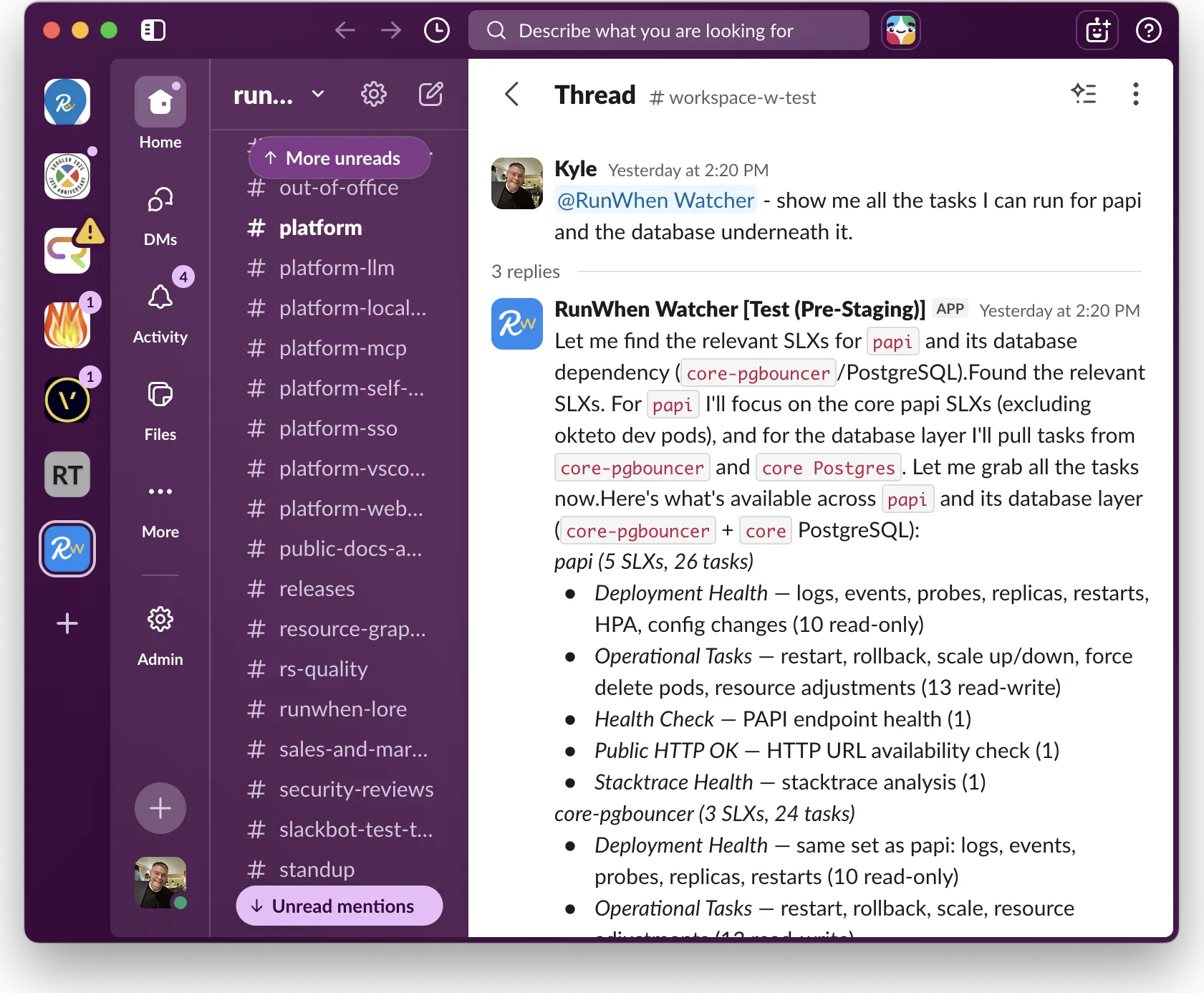
A read-only starting point: the agent answers from the safe-skill library rather than improvising a command.
Read it
Safe For Prod: Building Operational Agents — by Kyle Forster, April 2026.
If you would like to talk through what a safe-skill library would look like for your stack, or do a ‘guest on-call’ session in the RunWhen production environment with the agents our team uses every day, reach us at info@runwhen.com.
The skills themselves are open source and available in the RunWhen registry.